
Phoridae
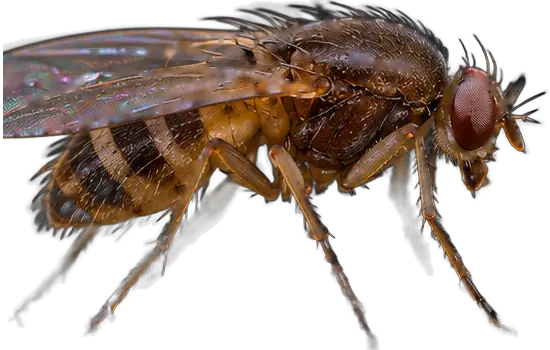
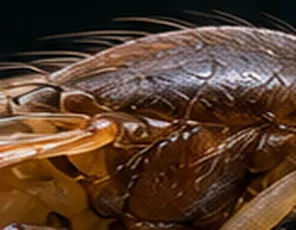
- 01Humped back. A strongly arched thorax. The reason they are also called humpbacked flies.
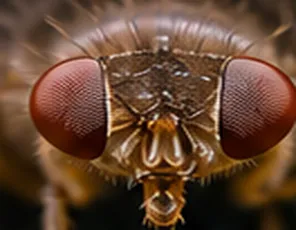
- 02Dark eyes. Not red. That separates them from fruit flies.
- 03Banded abdomen. Dark, often with lighter bands.
- 04Running legs. They scuttle across surfaces in short bursts instead of flying off.
- Adult size
- About 1/16 to 1/8 in
- Color
- Dark brown to black
- Breeds in
- Decaying organic matter, often a broken drain or sewer line
- Seen
- Bathrooms, basements, commercial kitchens
- Tip
- Any small fly without red eyes is worth identifying
Figures: Penn State Extension, Phorid Flies, University of Kentucky, Small Flies.
What does a phorid fly look like?
Small, dark brown to black, about the size of a fruit fly, with a strongly arched thorax that gives it a humpbacked profile. The eyes are dark, not red. The most telling feature is behavior: phorids scuttle across surfaces in quick, jerky runs, which is why they are also called scuttle flies.
Where do they breed?
In almost any moist, decaying organic matter. Penn State describes the family as more than 3,500 species worldwide, including the scuttle fly that turns up in homes. Common indoor sources are broken drain and sewer lines under slabs, leaks inside walls, garbage, and buildup in floor drains, grease traps and mop sinks.
Why are they one of the hardest fly problems?
Because the breeding site is so often hidden. When small dark flies keep appearing in a bathroom or basement after every drain has been cleaned, a broken pipe under the floor is a common cause. Treating the room does not help until the source is found and repaired.
How Graduate handles phorid flies
We confirm the identification, then trace the flies to their source using traps placed at each drain, crack and floor joint. Where everything points to a hidden line, we document the evidence so a plumber can camera and repair it. The fly control page explains the process.
Which fly is it?
Each fly points to a different breeding source. Tap one for its full profile.
- Size
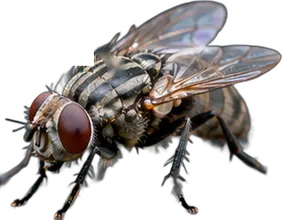
- About 1/4 in
- Look
- Gray, four dark stripes on the thorax
- Breeds in
- Garbage, manure, food waste
- Seen
- Kitchens, dumpster areas, around trash
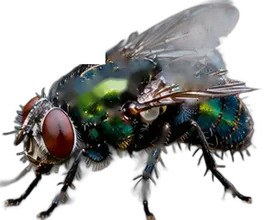
- Size
- 1/4 to 1/2 in
- Look
- Shiny metallic green, blue or copper
- Breeds in
- Dead animals, meat scraps, garbage
- Seen
- A sudden swarm often means a dead rodent in a wall
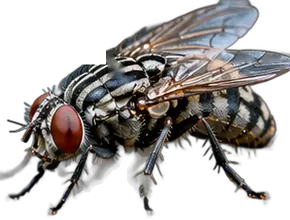
- Size
- 1/4 to 1/2 in
- Look
- Gray, three dark stripes, checkered abdomen
- Breeds in
- Carrion and decaying meat. Gives birth to live larvae
- Seen
- Near garbage, dumpsters, dead animals
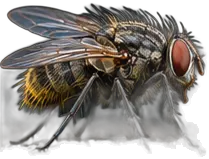
- Size
- 3/8 to 1/2 in, larger than a house fly
- Look
- Dull gray, golden hairs on the thorax
- Breeds in
- Outdoors. Larvae live in earthworms
- Seen
- Sunny windows and attics, fall through spring
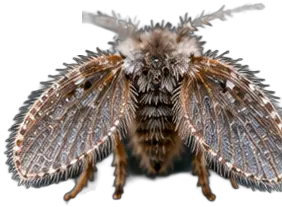
- Size
- 1/16 to 3/16 in
- Look
- Fuzzy, moth-like, wings held like a roof
- Breeds in
- Slime film inside drains and traps
- Seen
- Bathroom and kitchen walls near drains
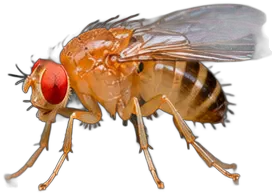
- Size
- About 1/8 in
- Look
- Tan, bright red eyes
- Breeds in
- Fermenting fruit, spills, drains, recycling
- Seen
- Hovering over produce and trash
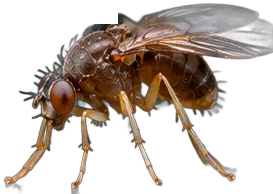
- Size
- 1/16 to 1/8 in
- Look
- Dark, humped back, runs in short bursts
- Breeds in
- Decaying matter, often a broken drain or sewer line under a slab
- Seen
- Bathrooms, basements, commercial kitchens
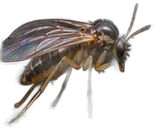
- Size
- 1/16 to 1/8 in
- Look
- Dark, slender, long legs and antennae
- Breeds in
- Wet potting soil and damp organic matter
- Seen
- Around houseplants and windows
Figures: University of Minnesota Extension, Flies, University of Kentucky, Small Flies, Penn State Extension, Cluster Flies.
Treatment for this pest is covered under Fly Control.
Common questions
How do I tell phorid flies from fruit flies?
Phorid flies are darker, have a distinctly humped back, and do not have red eyes. They also run in quick, jerky bursts across counters and walls. Penn State advises that any small fly in the home without red eyes should be identified by a professional.
We cleaned all the drains. Why are they still coming?
Because the source is probably out of reach: a cracked drain or sewer pipe under the floor slab, a leak inside a wall, or organic buildup in a crawlspace. These often need a plumber to camera the lines.
Are phorid flies dangerous?
They breed in decaying and sometimes unsanitary material and then land on surfaces and food, so they are treated as a sanitation problem, especially in food businesses and healthcare.
Why are they called coffin flies?
Some phorid species breed in buried remains, which earned the family that nickname. The species in homes breed in everyday decaying matter.
Can phorid flies breed in a garbage disposal or floor drain?
Yes. Organic buildup in disposals, floor drains, mop sinks and grease traps is a common source, especially in restaurants.
How do you confirm a broken pipe is the cause?
Traps placed at floor cracks, slab joints and drains show where flies are coming up. Concentrated catches away from any drain opening point to a hidden leak.
Get in touch
Tell us what you are seeing
Four questions, answered by a person within one business day. If it is urgent, call: the line is answered at any hour.
Fly Control
Start with a free consultation
A consultation is a phone call with us about your problem. You tell us what you are seeing, where in the building, and how long it has been going on. We tell you what it most likely is, what is causing it, and what it will take to fix. Most routine work can be priced on that call.
There is no charge and no obligation. If we are not the right fit, we will say so before anyone books a visit.
Call (631) 212-9601Schedule an inspection
Answered at any hour.