
Collembola
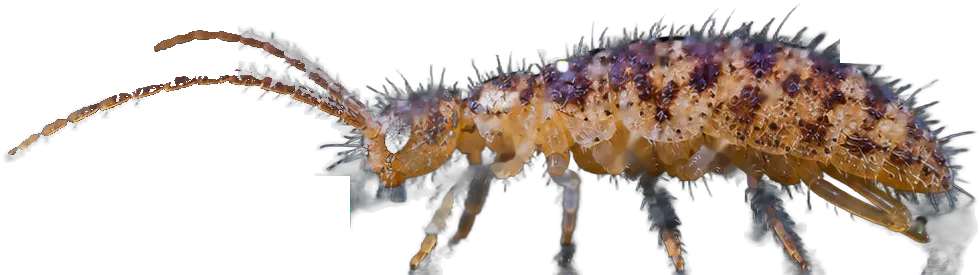
- 01Four-segment antennae. Long for its size, but only four true segments.
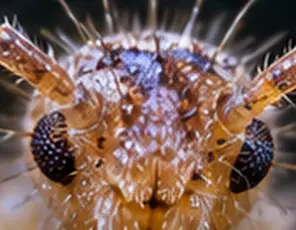
- 02Eye patch. A small dark cluster of up to eight simple eyes, not true compound eyes.
- 03No wings. Never has wings at any stage.
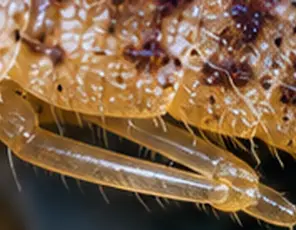
- 04Furcula. The forked spring folded under the tail. It snaps down and flings the springtail into the air.
- Size
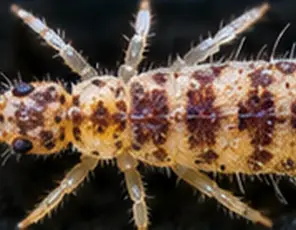
- 1/16 to 1/8 in
- Color
- White, gray, tan or mottled, by species
- Insect?
- No. A close six-legged relative
- Needs
- Constant moisture, mold, damp soil
- Harm
- Does not bite or damage the house
Figures: University of Kentucky, Springtails (ENT-420), Penn State Extension, Springtails.
What does a springtail look like?
Very small, usually 1/16 to 1/8 inch, soft-bodied and wingless, in white, gray, tan or mottled colors depending on the species. The antennae are short to fairly long but have only four true segments. Instead of compound eyes, each side of the head has a small dark patch of up to eight simple eyes. The giveaway is the furcula, a forked spring held folded under the abdomen. When it releases, the springtail snaps into the air.
Are springtails insects?
Not technically. They are six-legged arthropods in their own class, Collembola, closely related to insects. They also have a small tube under the body, the collophore, that helps them take up water. That dependence on moisture is the whole story indoors.
Where do they come from?
Outdoors they live by the millions in soil, mulch and leaf litter. They come in through gaps at doors, windows and the foundation, or in potted plant soil, and they stay where it is wet: sink and tub areas, window sills with condensation, damp basements and new construction that has not dried out.
How Graduate handles springtails
We find the moisture, because that is what keeps them alive. That can be a plumbing leak, condensation, overwatered plants, a wet crawl space or mulch piled against the house. Once the area dries out and the gaps are sealed, springtails die off quickly. See occasional invader control for the full approach.
Which occasional invader is it?
All four come in for moisture. Look at the tail end first. Tap one for its full profile.
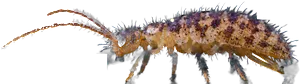
- Size
- 1/16 to 1/8 in
- Tail end
- Hidden jumping fork underneath
- Moves
- Pops into the air when touched
- Points to
- Wet soil, mold, leaks, overwatered plants

- Size
- About 1/2 in
- Tail end
- Three long bristles
- Moves
- Fast, fish-like wiggle
- Points to
- Damp basements, stored paper and boxes

- Size
- About 5/8 in
- Tail end
- Pincers (forceps)
- Moves
- Crawls, rarely flies
- Points to
- Wet mulch and leaf litter at the foundation
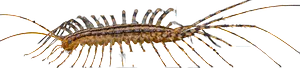
- Size
- 1 to 1 1/2 in body
- Tail end
- Very long last pair of legs
- Moves
- Very fast, up walls
- Points to
- Damp space and other insects to eat
Figures: University of Kentucky, Springtails (ENT-420), Penn State Extension, Silverfish and Firebrats, Penn State Extension, European Earwigs, Iowa State University Extension, House Centipede.
Treatment for this pest is covered under Occasional Invader Control.
Common questions
Do springtails bite?
No. There are no verified reports of springtails harming people or pets, and they do not damage the house.
Are they fleas?
No. Both are tiny and jump, but springtails stay near moisture, do not bite and do not live on pets. Fleas are flattened side to side, hump-backed and feed on blood.
Why are they in my houseplants?
Overwatered potting soil grows the mold and fungi springtails eat. Letting the soil dry between waterings usually ends it.
Why do they show up after rain or drought?
Both push them toward the house. Saturating rain floods their soil, and long dry spells send them looking for moisture, often right through gaps at the foundation, doors and windows.
Are springtails insects?
Technically no. They belong to the class Collembola, a separate group of six-legged arthropods closely related to insects.
How do I get rid of them?
Remove the moisture. Fix leaks and condensation, dry out the basement or crawl space, reduce overwatering, and seal gaps where they come in. Vacuuming handles the ones already inside.
Get in touch
Tell us what you are seeing
Four questions, answered by a person within one business day. If it is urgent, call: the line is answered at any hour.
Occasional Invader Control
Start with a free consultation
A consultation is a phone call with us about your problem. You tell us what you are seeing, where in the building, and how long it has been going on. We tell you what it most likely is, what is causing it, and what it will take to fix. Most routine work can be priced on that call.
There is no charge and no obligation. If we are not the right fit, we will say so before anyone books a visit.
Call (631) 212-9601Schedule an inspection
Answered at any hour.