
Get in touch
Tell us what you are seeing
Four questions, answered by a person within one business day. If it is urgent, call: the line is answered at any hour.
Springtails, silverfish, earwigs and centipedes come in for moisture and shelter. Dry the space and seal the gaps, and they stop coming in.
Which occasional invader is it?
All four come in for moisture. Look at the tail end first. Tap one for its full profile.
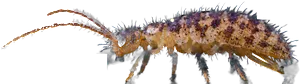
- Size
- 1/16 to 1/8 in
- Tail end
- Hidden jumping fork underneath
- Moves
- Pops into the air when touched
- Points to
- Wet soil, mold, leaks, overwatered plants

- Size
- About 1/2 in
- Tail end
- Three long bristles
- Moves
- Fast, fish-like wiggle
- Points to
- Damp basements, stored paper and boxes

- Size
- About 5/8 in
- Tail end
- Pincers (forceps)
- Moves
- Crawls, rarely flies
- Points to
- Wet mulch and leaf litter at the foundation
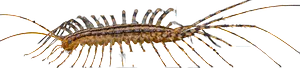
- Size
- 1 to 1 1/2 in body
- Tail end
- Very long last pair of legs
- Moves
- Very fast, up walls
- Points to
- Damp space and other insects to eat
Figures: University of Kentucky, Springtails (ENT-420), Penn State Extension, Silverfish and Firebrats, Penn State Extension, European Earwigs, Iowa State University Extension, House Centipede.
What are occasional invaders?
They are bugs that live outdoors in soil, mulch and leaf litter and only come inside when conditions push them: drought, heavy rain or the search for a damp place to hide. They do not nest in your walls the way ants or roaches do. Seeing them is a sign of two things: a damp space and a way in. The comparison above shows the four we see most on Long Island and in New York City. Tap any one for the full profile.
Springtail
Tiny, 1/16 to 1/8 inch, and they pop into the air when touched, thanks to a forked spring folded under the tail. Technically they are not insects but a close six-legged relative. They live on mold and fungi, so indoors they point to wet soil in potted plants, leaks, condensation, wet window sills and damp basements.
Full profile: Springtail.
Silverfish
Silvery, carrot-shaped, about 1/2 inch, with long antennae and three long tail bristles. They prefer cool, damp rooms and eat starch: paper, book bindings, wallpaper paste, cardboard and cereals. Boxes of stored papers in a damp basement are the classic source.
Full profile: Silverfish.
European earwig
Reddish brown, about 5/8 inch, with pincers at the tail. They hide in wet mulch, leaf litter and under stones by day and come out at night. Heavy mulch against the foundation is the most common reason they end up inside.
Full profile: European earwig.
House centipede
The fast, many-legged one on the bathroom wall. It has 15 pairs of long banded legs, a body 1 to 1 1/2 inches long, and hunts other insects and spiders. It can live its whole life indoors where it stays damp and there is enough to eat.
Full profile: House centipede.
How Graduate handles occasional invaders
We identify what you are seeing, then find the moisture and the entry points. That means checking grading, gutters and downspouts, mulch depth against the foundation, the sill and band joist, door sweeps, window wells and every pipe and wire that enters the house. We seal the gaps with durable materials, recommend dehumidification or drainage fixes where needed, and place monitors to confirm the result. The sealing is the same work we do in structural exclusion.
Common questions
Why do these bugs keep showing up in my basement?
Moisture. Springtails, silverfish, earwigs and house centipedes all need damp conditions, and basements, crawl spaces and bathrooms give them that. They walk in through gaps at the sill, doors, window wells and utility lines.
Are any of them dangerous?
Not really. Springtails and earwigs are harmless. House centipedes rarely bite, and a bite is about like a bee sting. Silverfish do not bite but can damage paper, books and starched fabric.
Should I kill the house centipedes?
They eat roaches, silverfish, spiders and other insects, so a lot of centipedes usually means a lot of something else to eat. Fixing moisture and the insect supply takes care of both.
The tiny jumping bugs near my sink, are they fleas?
Probably springtails. They are about the same size and both jump, but springtails stay near moisture, do not bite and do not live on pets. Fleas are hump-backed and go after people and animals.
Will a spray solve it?
Only briefly. As long as the space stays damp and the gaps stay open, more come in. Moisture control and sealing are what last.
When are they worst?
After long dry spells or heavy rain, when conditions outside push them toward the foundation. Earwigs and springtails often show up in numbers in summer and early fall.
Occasional Invader Control
Start with a free consultation
A consultation is a phone call with us about your problem. You tell us what you are seeing, where in the building, and how long it has been going on. We tell you what it most likely is, what is causing it, and what it will take to fix. Most routine work can be priced on that call.
There is no charge and no obligation. If we are not the right fit, we will say so before anyone books a visit.
Call (631) 212-9601Schedule an inspection
Answered at any hour.