
Scutigera coleoptrata
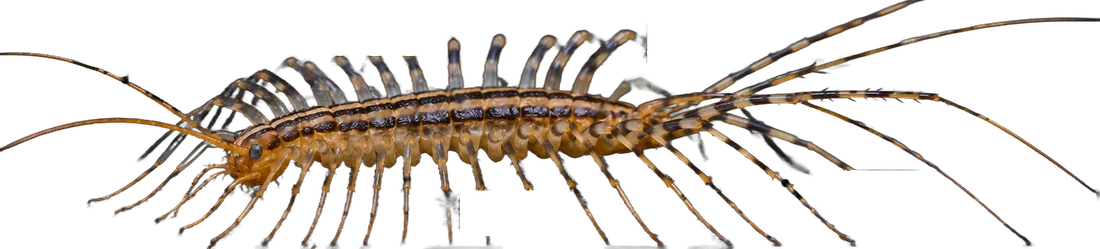
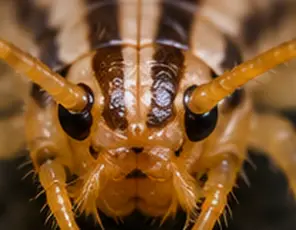
- 01Long antennae. Longer than the body, always sweeping.
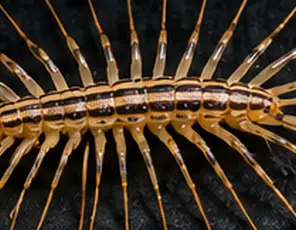
- 02Three dark stripes. Run the full length of the grayish-yellow back.
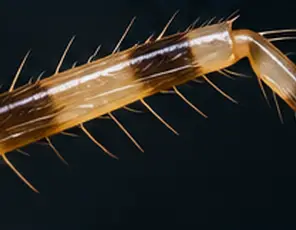
- 0315 pairs of legs. Long, banded legs, one pair per segment. Juveniles start with 4 pairs.
- 04Longest legs at the rear. The last pair can be twice the body length and is often mistaken for antennae.
- Body
- 1 to 1 1/2 in, legs not included
- Color
- Grayish yellow, three dark stripes
- Eats
- Spiders, roaches, silverfish, flies and other insects
- Bite
- Rare, about like a bee sting
- Lives
- Damp basements, bathrooms, closets
Figures: Iowa State University Extension, House Centipede, Washington State University, House Centipede.
What does a house centipede look like?
A grayish-yellow body 1 to 1 1/2 inches long with three dark stripes running down the back. Adults have 15 pairs of very long, thin legs banded light and dark, one pair per body segment. The antennae are longer than the body, and the last pair of legs is so long it is often mistaken for a second set of antennae. It runs with its body held high and can cross a wall or ceiling in seconds.
Is it an insect?
No. Centipedes are arthropods in their own class, Chilopoda. They have a pair of venom claws just behind the head that they use to catch prey.
What does it eat?
Other bugs: spiders, cockroaches, silverfish, flies, moths, earwigs and bed bugs. That is why centipede sightings are often a clue to a second pest problem.
How Graduate handles house centipedes
We go after the conditions they need: moisture in basements, bathrooms and crawl spaces, clutter where they hide, and the other insects they feed on. We seal entry points so fewer insects get in for them to eat. See occasional invader control for how they compare with springtails, silverfish and earwigs.
Which occasional invader is it?
All four come in for moisture. Look at the tail end first. Tap one for its full profile.
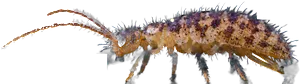
- Size
- 1/16 to 1/8 in
- Tail end
- Hidden jumping fork underneath
- Moves
- Pops into the air when touched
- Points to
- Wet soil, mold, leaks, overwatered plants

- Size
- About 1/2 in
- Tail end
- Three long bristles
- Moves
- Fast, fish-like wiggle
- Points to
- Damp basements, stored paper and boxes

- Size
- About 5/8 in
- Tail end
- Pincers (forceps)
- Moves
- Crawls, rarely flies
- Points to
- Wet mulch and leaf litter at the foundation
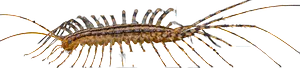
- Size
- 1 to 1 1/2 in body
- Tail end
- Very long last pair of legs
- Moves
- Very fast, up walls
- Points to
- Damp space and other insects to eat
Figures: University of Kentucky, Springtails (ENT-420), Penn State Extension, Silverfish and Firebrats, Penn State Extension, European Earwigs, Iowa State University Extension, House Centipede.
Treatment for this pest is covered under Occasional Invader Control.
Common questions
Do house centipedes bite?
Rarely, and only if handled. Iowa State and other extension sources consider them harmless to people. A bite is usually no worse than a bee sting.
Why do I have so many?
Because there is moisture and food. They eat other insects and spiders, so a lot of centipedes usually means a lot of something else to eat.
Are they good to have around?
They do eat pests, but most people do not want them. Cutting off their moisture and their prey is the way to reduce them.
How many legs do they have?
Adults have 15 pairs. Juveniles hatch with 4 pairs and add more each time they molt.
Do they come up through the drains?
No. They are often found in tubs and sinks because they fall in and cannot climb the smooth sides, not because they came up the pipe.
How do I get rid of them?
Dry out basements, bathrooms and crawl spaces, reduce clutter where they hide, seal gaps where insects get in, and the centipedes lose both their shelter and their food.
Get in touch
Tell us what you are seeing
Four questions, answered by a person within one business day. If it is urgent, call: the line is answered at any hour.
Occasional Invader Control
Start with a free consultation
A consultation is a phone call with us about your problem. You tell us what you are seeing, where in the building, and how long it has been going on. We tell you what it most likely is, what is causing it, and what it will take to fix. Most routine work can be priced on that call.
There is no charge and no obligation. If we are not the right fit, we will say so before anyone books a visit.
Call (631) 212-9601Schedule an inspection
Answered at any hour.