
Forficula auricularia

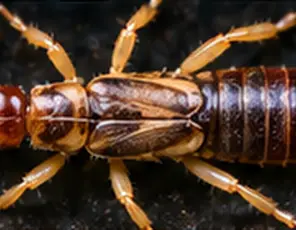
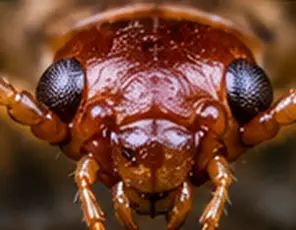
- 01Beaded antennae. Long and slender, made of many bead-like segments.
- 02Reddish head. Darker red than the body. Legs are pale yellow-brown.
- 03Short wing covers. Leathery pads over folded hind wings. They rarely fly.
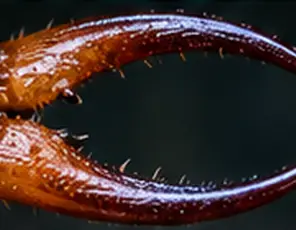
- 04Forceps. Curved in males, as here; nearly straight in females.
- Size
- About 5/8 in
- Color
- Dark reddish brown, red head, pale legs
- Active
- At night; hides in mulch and cracks by day
- Comes in
- Hot, dry spells or heavy rain
- Harm
- Nuisance. Chews soft plants outdoors
Figures: Penn State Extension, European Earwigs, University of Florida, European Earwig (EENY-483).
What does a European earwig look like?
About 5/8 inch long, flattened and dark reddish brown, with a redder head and pale yellow-brown legs. The antennae are long and beaded. Short, leathery wing covers sit just behind the head with the hind wings folded under them, and earwigs rarely fly. The pincers, or forceps, at the tail are curved in males and nearly straight in females.
Why do they come inside?
They live in mulch, leaf litter, under stones and in cracks outdoors. Hot, dry weather sends them looking for moisture, and heavy rain floods them out. Either way, a foundation lined with wet mulch puts them a few inches from the door.
Are they harmful?
No. They do not bite, and the pinch is weak. They are a nuisance indoors and a minor plant pest outdoors, where they also eat aphids and other small insects.
How Graduate handles earwigs
We look at the outside first: mulch depth, ground cover, drainage and downspouts. Then we seal the gaps at doors, sills, window wells and utility lines. See occasional invader control for the full approach.
Which occasional invader is it?
All four come in for moisture. Look at the tail end first. Tap one for its full profile.
- Size
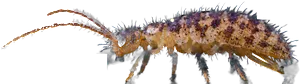
- 1/16 to 1/8 in
- Tail end
- Hidden jumping fork underneath
- Moves
- Pops into the air when touched
- Points to
- Wet soil, mold, leaks, overwatered plants

- Size
- About 1/2 in
- Tail end
- Three long bristles
- Moves
- Fast, fish-like wiggle
- Points to
- Damp basements, stored paper and boxes

- Size
- About 5/8 in
- Tail end
- Pincers (forceps)
- Moves
- Crawls, rarely flies
- Points to
- Wet mulch and leaf litter at the foundation
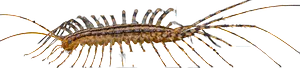
- Size
- 1 to 1 1/2 in body
- Tail end
- Very long last pair of legs
- Moves
- Very fast, up walls
- Points to
- Damp space and other insects to eat
Figures: University of Kentucky, Springtails (ENT-420), Penn State Extension, Silverfish and Firebrats, Penn State Extension, European Earwigs, Iowa State University Extension, House Centipede.
Treatment for this pest is covered under Occasional Invader Control.
Common questions
Do earwigs crawl into ears?
No. That is a myth. Earwigs hide in tight, dark, damp places, but there is nothing special about ears.
Can they pinch?
They can squeeze with the forceps if handled, but it is weak and harmless. The pincers are mostly for defense and catching prey.
How do I tell males from females?
By the forceps. Males have strongly curved pincers. Females have straighter forceps that curve only slightly at the tip.
Why are there so many around the house?
Heavy mulch, leaf litter, ground cover and damp soil against the foundation give them shelter. Leaky downspouts and irrigation make it worse.
Do earwigs damage anything?
Outdoors they chew on soft plants and flowers, but they also eat aphids and other small insects. Indoors they do no damage.
How do I keep them out?
Pull mulch back from the foundation, fix downspouts and drainage, and seal gaps at doors, sills and window wells.
Get in touch
Tell us what you are seeing
Four questions, answered by a person within one business day. If it is urgent, call: the line is answered at any hour.
Occasional Invader Control
Start with a free consultation
A consultation is a phone call with us about your problem. You tell us what you are seeing, where in the building, and how long it has been going on. We tell you what it most likely is, what is causing it, and what it will take to fix. Most routine work can be priced on that call.
There is no charge and no obligation. If we are not the right fit, we will say so before anyone books a visit.
Call (631) 212-9601Schedule an inspection
Answered at any hour.