
Plodia interpunctella
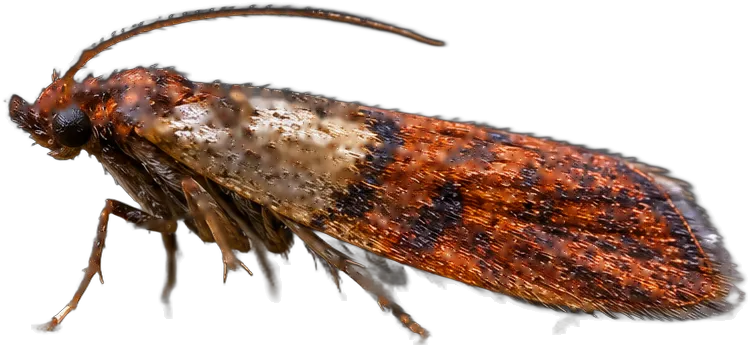
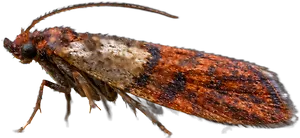
- 01Small head, long antennae. Thin antennae swept back over the body.
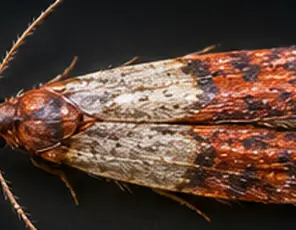
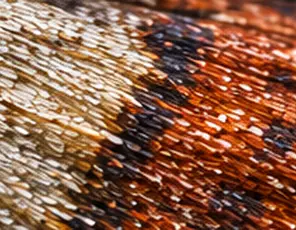
- 02Pale base. The inner third of each forewing is pale gray to tan.
- 03Copper outer half. The outer two thirds are copper to reddish brown. Two tones is the giveaway.
- 04Wings held like a roof. Folded close over the body at rest.
- Wingspan
- 1/2 to 5/8 in
- Body
- About 1/4 in
- Larva
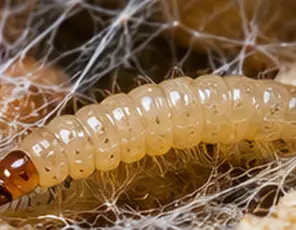
- Off-white, brown head, up to 1/2 in
- Eats
- Cereal, flour, nuts, dried fruit, spices, chocolate, pet food, birdseed
- Seen
- Flying in kitchens at night; larvae crawling up walls to pupate
Figures: University of Minnesota Extension, Indianmeal moth, Purdue Extension, Indianmeal Moth (E-223).
What does an Indianmeal moth look like?
A small moth, about a quarter inch long at rest, with a wingspan of roughly half to five eighths of an inch. The forewings are two-tone: pale gray or tan on the inner part and copper to reddish brown on the outer part. At rest the wings fold close over the body like a roof. In dim light some look almost black.
What do the larvae look like?
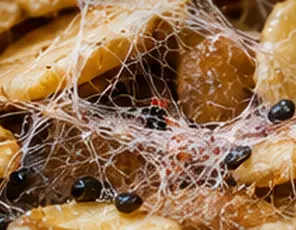
Off-white caterpillars, sometimes tinted green or pink by what they have been eating, with a brown head. Full grown they reach about half an inch. They leave silk webbing, droppings and shed skins through the food, and infested cereal or grain often clumps together.
What do they eat?
Almost any dry plant-based food: cereal, flour, cornmeal, pasta, rice, nuts, seeds, dried fruit, chocolate, spices, dry pet food and birdseed. They also turn up in dried flower arrangements, craft supplies with seeds, and nuts that mice have stashed in walls or attics.
How Graduate handles Indianmeal moths
We go through every place food is kept, including pet food, the garage, holiday baking supplies and decorative items, until the infested products are found. Those are removed, shelves and cracks are vacuumed, and clean food is sealed. Traps then confirm the population is gone. See stored product pest control for the full approach.
Which moth is it?
One eats your food, two eat your wool. Tap a moth for its full profile.
- Wingspan
- 1/2 to 5/8 in
- Look
- Two-tone wings: pale base, copper-brown outer half
- Larvae eat
- Dry foods: cereal, flour, nuts, dried fruit, pet food, birdseed
- Seen
- Kitchens and pantries. Webbing in food
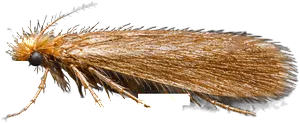
- Wingspan
- About 1/2 in, body about 1/4 in
- Look
- Plain golden wings, reddish-gold head tuft
- Larvae eat
- Wool, silk, fur, feathers. Not food
- Seen
- Closets, rugs, stored textiles. Avoids light
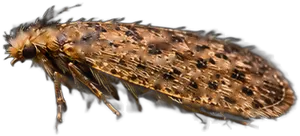
- Wingspan
- 3/8 to 1/2 in
- Look
- Brownish wings with faint dark spots
- Larvae eat
- Wool, fur, feathers, hides. Not food
- Seen
- Larva drags a small silk case. Closets, attics
Figures: University of Minnesota Extension, Indianmeal moth, Rutgers NJAES, Clothes Moths (FS1182), University of Florida, Clothes Moths (IG090).
Treatment for this pest is covered under Stored Product Pest Control.
Common questions
Where do Indianmeal moths come from?
Usually from a package brought home with eggs or small larvae already inside. Dry pet food and birdseed are among the most common sources, followed by cereal, flour, nuts and dried fruit.
Why are there caterpillars on my ceiling?
Full grown larvae leave the food to find a protected spot to pupate. They crawl up walls, across ceilings and into the corners of cabinets. It means there is an infested product somewhere below.
Can they get into sealed packages?
Young larvae can chew through paper, thin plastic and cellophane, and slip through folds and pinholes. Glass jars and hard plastic containers with tight lids keep them out.
Do the moths themselves eat food?
No. Adults do not feed on stored products. All the damage, webbing and contamination comes from the larvae.
Will a pheromone trap solve it?
A trap catches males and confirms the species, and the trap counts help narrow down where the source is. It does not remove the larvae already in food, so the infested product still has to be found.
Are Indianmeal moths the same as clothes moths?
No. Clothes moths are smaller, plain golden or brownish, avoid light and eat wool and other animal fibers. Indianmeal moths have two-tone wings, fly around kitchens and eat dry food.
Get in touch
Tell us what you are seeing
Four questions, answered by a person within one business day. If it is urgent, call: the line is answered at any hour.
Stored Product Pest Control
Start with a free consultation
A consultation is a phone call with us about your problem. You tell us what you are seeing, where in the building, and how long it has been going on. We tell you what it most likely is, what is causing it, and what it will take to fix. Most routine work can be priced on that call.
There is no charge and no obligation. If we are not the right fit, we will say so before anyone books a visit.
Call (631) 212-9601Schedule an inspection
Answered at any hour.