
Tinea pellionella
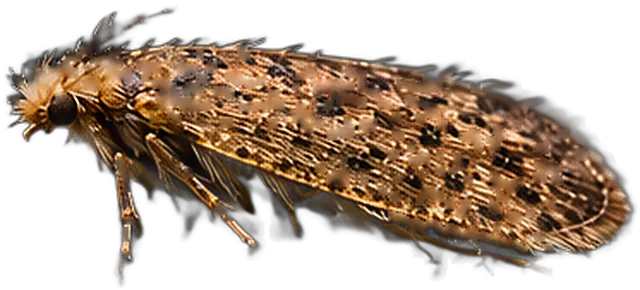
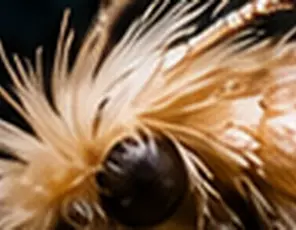
- 01Pale head tuft. Lighter than the webbing clothes moth tuft.
- 02Faint dark spots. Brownish wings with dark spots, often three. They rub off with wear.
- 03Narrow, fringed wings. Held close along the body at rest.
- Wingspan
- 3/8 to 1/2 in
- Color
- Buff to brownish, faint dark spots
- Larvae eat
- Wool, fur, feathers, hides. Not food
- Signs
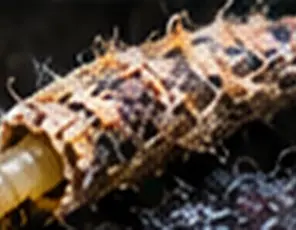
- Small tube-shaped cases on fabric, walls and baseboards
- Seen
- Closets, attics, stored textiles
Figures: Rutgers NJAES, Clothes Moths (FS1182), University of Florida, Clothes Moths (IG090).
What does a casemaking clothes moth look like?
A small moth with a wingspan of about three eighths to half an inch. The wings are buff to brownish with faint dark spots, often three on each forewing, which can rub off with age. The head tuft is paler than on the webbing clothes moth. The wings are narrow and fringed, held close along the body at rest.
What does the larva look like?
A white caterpillar with a dark head, hidden inside a flattened silk case it carries everywhere. The case is covered in bits of the material it has been eating, so it blends in with the fabric. The larva pokes its head and front legs out to feed and pulls back in when disturbed.
What does it damage?
Wool, fur, feathers, hair, hides, felt and other animal products. Feeding leaves holes, surface grazing and thinned areas, with cases and droppings on or near the damaged item.
How Graduate handles casemaking clothes moths
We find the source item, which is often stored wool, a fur, feathered decor or an old rug, and treat or remove it. Cases on walls and baseboards are vacuumed up, and traps confirm nothing is left. See stored product pest control for how this moth compares with pantry moths.
Which moth is it?
One eats your food, two eat your wool. Tap a moth for its full profile.
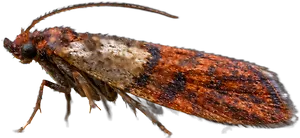
- Wingspan
- 1/2 to 5/8 in
- Look
- Two-tone wings: pale base, copper-brown outer half
- Larvae eat
- Dry foods: cereal, flour, nuts, dried fruit, pet food, birdseed
- Seen
- Kitchens and pantries. Webbing in food
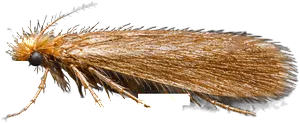
- Wingspan
- About 1/2 in, body about 1/4 in
- Look
- Plain golden wings, reddish-gold head tuft
- Larvae eat
- Wool, silk, fur, feathers. Not food
- Seen
- Closets, rugs, stored textiles. Avoids light
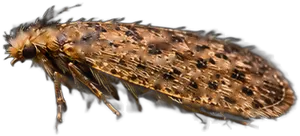
- Wingspan
- 3/8 to 1/2 in
- Look
- Brownish wings with faint dark spots
- Larvae eat
- Wool, fur, feathers, hides. Not food
- Seen
- Larva drags a small silk case. Closets, attics
Figures: University of Minnesota Extension, Indianmeal moth, Rutgers NJAES, Clothes Moths (FS1182), University of Florida, Clothes Moths (IG090).
Treatment for this pest is covered under Stored Product Pest Control.
Common questions
What are the little tubes on my sweater or wall?
Most likely casemaking clothes moth larvae in their cases. The larva lives inside a silk tube covered in fibers from whatever it has been eating, so the case often matches the fabric color.
Why are the cases on the wall and ceiling?
Larvae ready to pupate often wander away from the food source, sometimes a long way, to attach the case in a protected crack or along the line where wall meets ceiling.
Is it common?
Less common than the webbing clothes moth, but it turns up in closets, attics and anywhere wool, fur, feathers or hides are stored for a long time.
Does it eat food?
No. Like the webbing clothes moth, its larvae feed on animal fibers that contain keratin. It is not a pantry pest.
How do I tell it from the webbing clothes moth?
The casemaking clothes moth is browner, with faint dark spots that can rub off. The webbing clothes moth is plain golden. The larvae settle it: a portable case versus webbing on the fabric.
What should I do with infested items?
Clean, launder or dry clean what can be saved, freeze items that cannot be washed, and discard what is too damaged. Vacuum closets and baseboards to pick up cases and eggs.
Get in touch
Tell us what you are seeing
Four questions, answered by a person within one business day. If it is urgent, call: the line is answered at any hour.
Stored Product Pest Control
Start with a free consultation
A consultation is a phone call with us about your problem. You tell us what you are seeing, where in the building, and how long it has been going on. We tell you what it most likely is, what is causing it, and what it will take to fix. Most routine work can be priced on that call.
There is no charge and no obligation. If we are not the right fit, we will say so before anyone books a visit.
Call (631) 212-9601Schedule an inspection
Answered at any hour.