
Rodent pressure and the evidence it leaves · reviewed November 2026
Key points:
- Mice still showing up is proof that an opening still exists. A claim that the apartment is sealed does not change that.
- The space behind and beneath a dishwasher is the biggest unseen area in most kitchens, and it sits in front of a wall that was opened for plumbing and power.
- What usually gets sealed is what can be seen. The hole that matters is behind something nobody moved.
- Sebum staining, droppings and grease drippings at an opening mark it as an active entry point.
- Graduate does not take anyone’s word that a building is sealed, including the owner’s, the super’s or the managing agent’s. We find out for ourselves.
What happened in this Brooklyn apartment?
The short version: three people swore the kitchen was sealed, the mice kept coming, and the hole was behind the dishwasher with a 2x4 standing in front of it.
We were called into an apartment in Brooklyn with a mouse problem that would not end. By the time we arrived, the homeowner, the super and the property manager had all reached the same conclusion: everything was sealed. Somebody had been through the kitchen. The plates around the pipes had been dealt with. The obvious gaps had been closed. As far as everyone in the building was concerned, the structure was finished and the mice were a mystery.
The mice disagreed. They were still being seen. They were still leaving droppings. And a mouse cannot be in a kitchen it has no way into.
So we asked for the dishwasher to come out. That request was not popular. The homeowner, the super and the property manager all pushed back. Pulling an appliance is a disruption, it involves the plumbing and the power, and from where they stood it was unnecessary because the kitchen was already sealed. We insisted anyway, for the only reason that matters: the activity was continuing, and continuing activity means there is a hole.
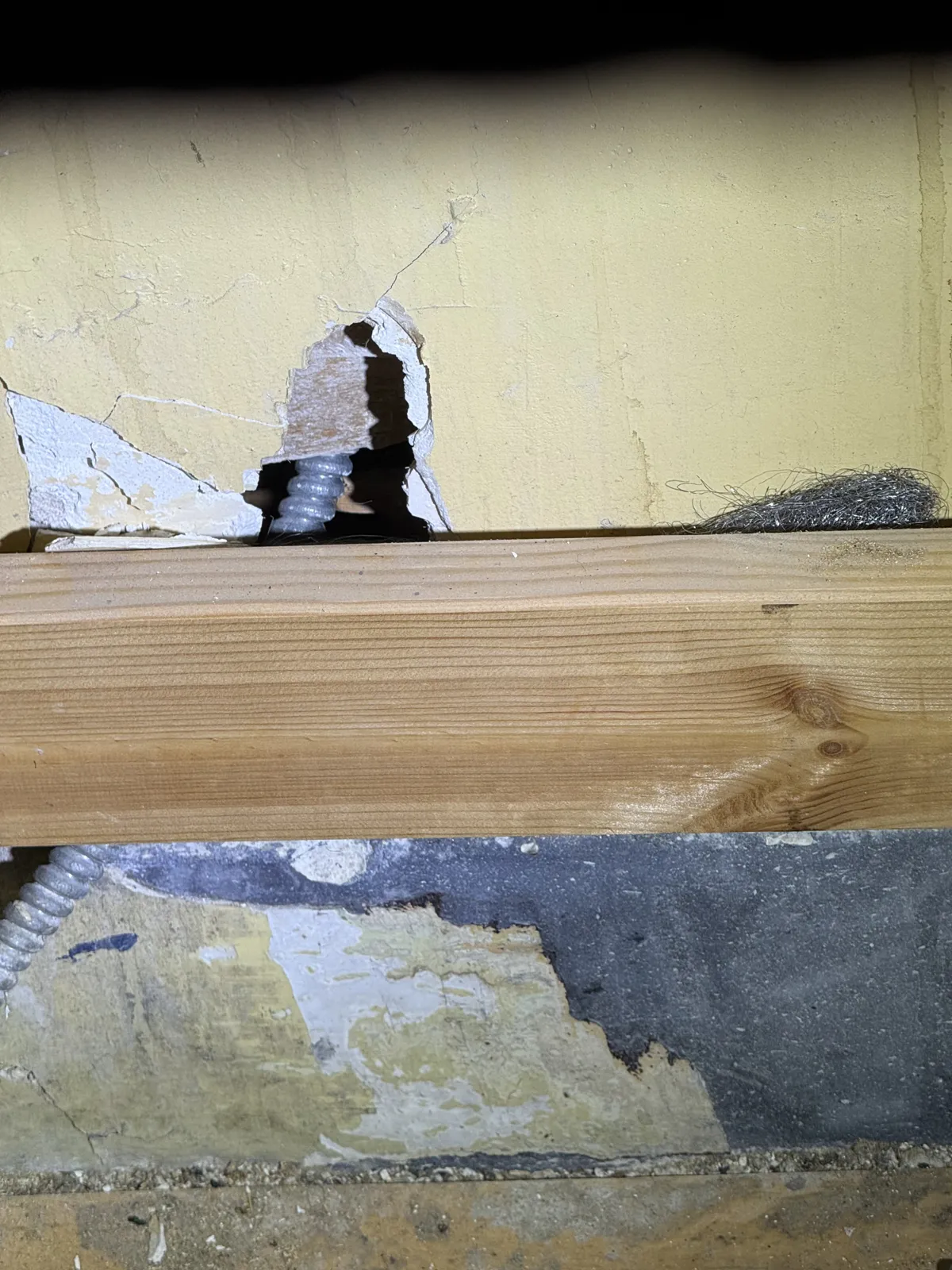
The dishwasher came out. Behind it, a 2x4 had been set in front of the wall. We removed it. Behind the 2x4 was the opening, and around the opening was everything that proves a hole is in use: dark sebum staining on the edges where the animals brushed through, droppings, and grease drippings collected below it. That was the route. The mice had been traveling in and out of that opening every night while everyone agreed the apartment was sealed.
The photo at the top of this page is that wall. The broken plaster opens straight into the void, with the electrical line for the appliance running through it. To the right, a wad of steel wool sits in a gap along the same board, which is what passes for sealed in a lot of kitchens. The dark staining on the wall below is what months of traffic leaves behind.
Nobody in that building was lying. They believed what they told us. They had sealed everything they could see. The problem is that what you can see is not where the mice are.
Why does “everything is sealed” so often turn out to be wrong?
Because people seal what they can see, and mice use what nobody looks at.
When a super or a handyman seals a kitchen, the work almost always follows the line of sight. Open the sink cabinet, look at the pipes, fill the gap around the escutcheon plates, close the hole in the cabinet floor, maybe run a bead along the backsplash. Each of those is a real opening and each of them is worth closing. But every one of them sits in a place a person was already looking.
The places nobody looks are the ones with something in front of them. A refrigerator. A range. A dishwasher. A base cabinet with a toe kick. A wall behind a stacked washer and dryer. In each case the opening is not hidden on purpose. It is hidden by an object that was installed after the hole was made and has stood in front of it ever since.
There is also the question of what “sealed” means to the person who said it. In our experience it very often means foamed. Expanding foam is the default closure in the trade, it looks finished, and it is soft enough for a mouse to work through. A foamed gap also photographs as done and is never inspected again, so a building can carry a long list of “sealed” openings that are in fact open. Graduate does not use foam in any role, and the structural exclusion page sets out what goes in instead.
The point is not that the homeowner, the super or the property manager did bad work. The point is that “sealed” is a statement about what someone did, not a finding about the building. The building is the only witness that matters, and in that kitchen the building was telling a different story every night.
Why is the dishwasher such a common entry point?
Because it sits in front of a wall that had to be opened to feed it, and then it hides that wall for as long as it is installed.
Think about what a dishwasher needs. It needs a hot water supply. It needs a drain line, usually run through the side of the sink cabinet to the sink’s waste or a disposal. It needs power, either a hard-wired circuit or an outlet in the adjacent cabinet. Each of those services arrives through a hole: through the back wall, through the floor, or through the side panel of the cabinet next door.
Those holes are cut by whoever installed the line, and they are cut for that person’s convenience. The plumber wants room to swing a fitting. The electrician wants room to pull the cable. Nobody drilling them is thinking about a quarter-inch gap, and nobody comes back afterward to close the space around the line. Then the dishwasher slides in, and the whole arrangement disappears.
What is left behind the appliance is the largest uninspected area in most kitchens: a dark cavity under the counter, open at the floor, connected to the sink cabinet through the drain and supply holes, connected to the wall through whatever was cut for the services, and warm from the appliance itself. It is close to water and close to food. For a mouse, it is close to ideal.
In an apartment building, that wall does not stop at the kitchen. The plumbing behind a kitchen usually connects to a riser or chase that runs between floors, so the opening behind a dishwasher can be the end of a route that starts in a cellar, a neighboring apartment or a commercial space at street level. Sealing the visible openings in the unit does nothing about a route that arrives behind the one thing nobody moved.
How do you know a hole is the active entry point and not just a gap?
You read what the animals leave behind. Mice show you where they travel if you look for the right marks.
Sebum staining. A rodent’s coat carries oil and dirt. Animals using the same opening over and over brush against the same edges, and over weeks those edges turn dark and greasy. The University of Nebraska–Lincoln’s house mouse guidance describes these as smudge or rub marks, and they are among the most reliable signs of a regular route. Heavy, layered staining on the edges of a hole means it has been used many times. Light or absent staining means it may be an opening, but it is not the main one.
Droppings. Fresh droppings concentrated at an opening, with fewer the farther you move from it, describe animals arriving through that point and spreading out. Droppings scattered evenly across a kitchen tell you mice are present. Droppings piled at a hole tell you where they are coming from.
Drippings and debris. Behind an appliance, grease and food residue accumulate on the floor and collect on whatever the animals carry through. A hole with grease drippings and debris gathered beneath it is a hole with traffic.
Direction. Footprints in dust and tail drags show which way the animals are moving. Tracks that run out of an opening and into the room describe an entry point.
When we removed the 2x4 in that Brooklyn kitchen, every one of those marks was there at once. There was no interpretation required. That is the standard we hold ourselves to: we do not seal a hole because it might be the problem. We find the hole the evidence points to, and we can show the client why it is that one.
Why did we insist on pulling the dishwasher when everyone objected?
Because the activity was continuing, and continuing activity is the one fact nobody can argue with.
Every opinion in the room said the apartment was sealed. The mice said otherwise, and the mice were the only party in the conversation that was not guessing. Once every visible opening has been checked and the animals are still getting in, the only remaining question is where the invisible one is. In a kitchen, the dishwasher is the first place to look.
We understand why people object. Pulling an appliance is inconvenient. It means disconnecting the water, the drain and the power. It means a mess on the kitchen floor and a conversation with whoever maintains the appliance. And to someone who believes the job is finished, it looks like a contractor inventing work.
But leaving the dishwasher in place has a cost too, and it is a bigger one. The mice keep coming. The traps keep catching. The building keeps paying for service on a problem that will never end because the route is still open. Every month the dishwasher stays in place is another month of treating the symptom.
So we hold the line on this, politely and firmly. We listen to the client, the super and the managing agent. Their history of the building is useful information and we want all of it. But we do not take direction on where to look, and we do not accept “it’s sealed” as a reason to stop looking. We find out for ourselves.
What does it mean to dig for the hole?
It means following the evidence past the point where it is convenient to stop.
Inspection is not looking around a room. It is removing whatever stands between you and the structure until the structure answers the question. In practice that means:
Pull the appliance. Dishwasher, refrigerator, range, washer and dryer. If the activity points to the area and the appliance is in front of it, the appliance comes out.
Remove what is covering the wall. In the Brooklyn apartment it was a 2x4. In other kitchens it is a filler panel, a toe kick, a piece of cardboard, a cabinet back, or a tile that was never set. Anything placed in front of the wall after the services went in can be hiding the opening the services created.
Trace every line to the wall. Supply, drain, gas and electrical lines do not start at the cabinet. Follow each one back to where it actually passes through the wall or the floor. That penetration is the one that matters, and it is often well behind the point where most inspections stop.
Remove the escutcheon plates. A chrome plate around a pipe covers the hole. It does not seal it. Every plate comes off so the opening behind it can be seen.
Read the evidence at every opening. Sebum, droppings, drippings, tracks. The hole with the heaviest evidence is the active route. There is often more than one.
Photograph it before it is closed. The photo is the proof for the client, the super and the managing agent, and it is the record for the account. In the Brooklyn apartment, the photograph of the opening behind the 2x4 settled the argument in a way no explanation could have.
None of this is exotic. It is simply refusing to stop at the face of the cabinet. Most failed rodent work in apartments does not fail because the wrong product was used. It fails because the inspection ended at the first surface that looked finished.
Why does trapping alone never settle a problem like this?
Because traps tell you the animals are there. They do not close the door they came through.
Traps are an information tool. Placed correctly in a runway, they confirm where animals are traveling and which way they are moving, and that information is part of how the entry point is found. They also remove animals. What they cannot do is change the building. As long as the opening behind the dishwasher stays open, the kitchen stays connected to whatever population is on the other side of the wall, and new animals keep arriving to replace the ones that were caught.
That is the pattern in a building like this one: a trap program that catches mice month after month, a kitchen that everyone believes is sealed, and a growing sense that the problem is unusual or that the pest company is not doing its job. The problem was never unusual. The route was simply behind something nobody moved.
Once the opening is found, it is closed with materials a mouse cannot work through. Around pipes and in masonry, that means cement and mortar or Xcluder fill fabric where a line needs to keep some movement. Larger openings get custom-fabricated 26-gauge galvanized sheet metal, fastened in place. Not foam, and not steel wool on its own. Then the trapping continues long enough to confirm the activity has actually stopped. The rodent control page covers how that sequence runs.
What should an owner, super or managing agent take from this?
That “sealed” is a conclusion you should reach from evidence, and the evidence is whether the animals have stopped.
If mice are still being seen, the apartment is not sealed, no matter how much work has gone into it or who did it. That is not a criticism. It is the most useful fact anyone has about the problem, because it tells you the opening still exists and that it is somewhere nobody has looked yet.
In New York City there is a compliance side to this as well. Local Law 55 of 2018 requires owners to take reasonable measures to keep premises free of pests, and it names the physical work directly, including repairing and sealing holes and gaps in walls, floors and baseboards and around pipes and conduits. A hole behind a dishwasher is exactly the kind of opening the law describes. Bait and traps alone do not do what the statute asks.
When the activity continues, ask the questions that move the inspection forward. Has every appliance in the affected room been pulled? Has every line been traced to the wall? Have the escutcheon plates come off? Has anything been sitting in front of the wall that nobody has moved? If the answer to any of those is no, the inspection is not finished.
That is how we work. We listen to everyone who knows the building, and then we go and find out for ourselves. In that Brooklyn kitchen, the answer was behind a dishwasher and a 2x4, exactly where the mice had been telling everyone it was. You can read more about how we read a building on the blog, or contact us if the mice in your building have outlasted the claim that it is sealed.
Field record
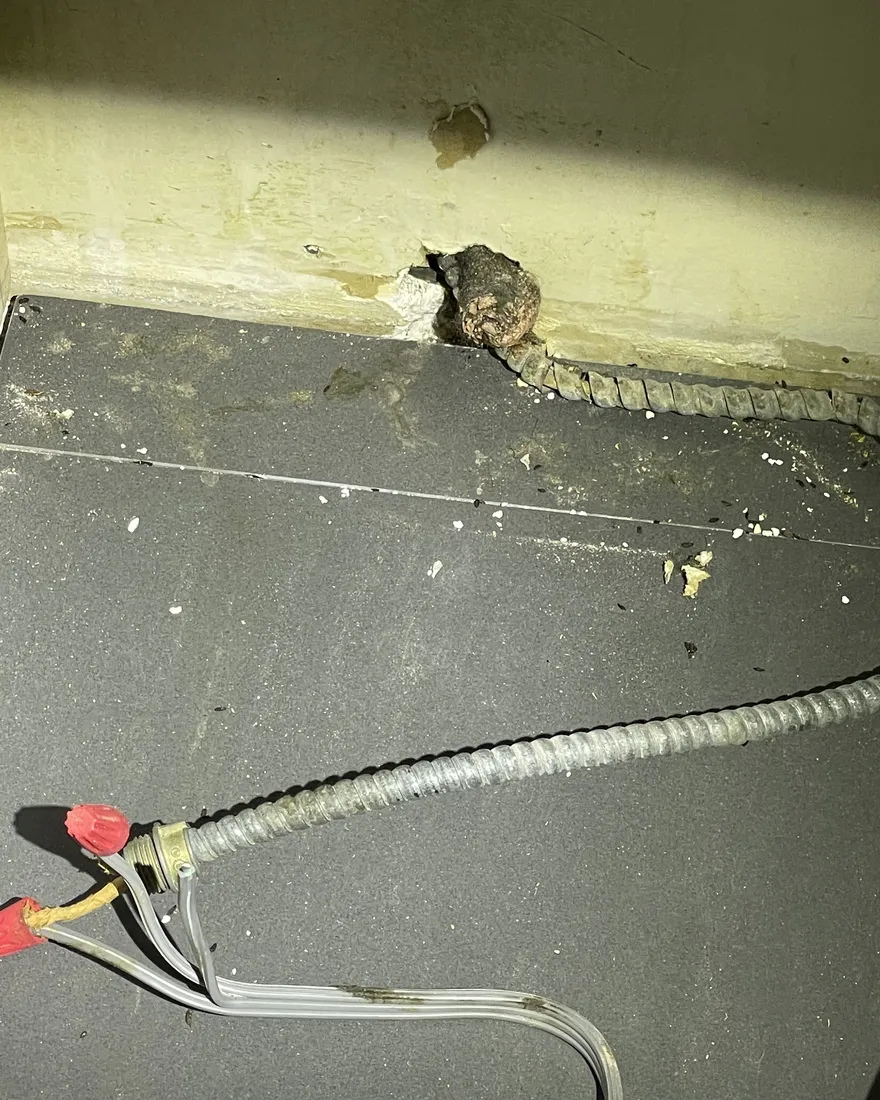
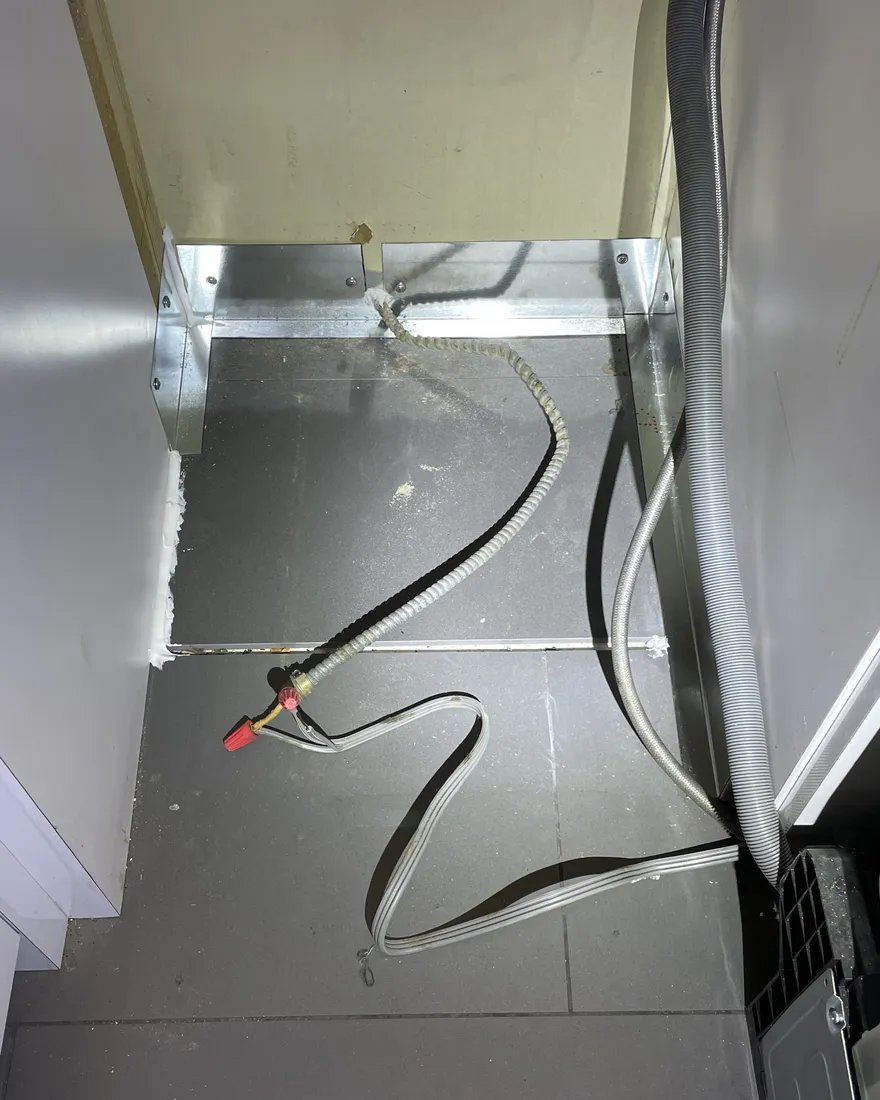
The same problem on another job
Drag the handle to compare before and after.
The work behind this piece is Rodent Control, and everything else in this cluster is indexed on the blog hub.
Also in rodent pressure and the evidence it leaves
Common questions
If my super says the apartment is sealed, why do I still have mice?
Because continued activity is the evidence that an opening still exists. A mouse cannot be in a kitchen it has no way into. Usually what was sealed is what could be seen: the escutcheon plates and the cabinet floor. The opening that matters is behind something nobody moved.
Why do mice come in behind the dishwasher?
Because a dishwasher sits in front of a wall that had to be opened to feed it. Hot water supply, a drain line and power all come through that wall or through the cabinet beside it, and the holes are cut for the installer's convenience, not to keep animals out. The appliance then hides the whole area for as long as it is installed.
Is pulling out a dishwasher really necessary for a mouse problem?
When activity continues in a kitchen and every visible opening has been closed, yes. The space behind and beneath the dishwasher is the largest part of a kitchen that nobody ever sees. You cannot seal a hole you have not found, and you cannot find this one with the appliance in place.
What does sebum staining around a hole mean?
Sebum is the oil from a rodent's coat. Animals using the same opening night after night leave a dark, greasy rub mark on the edges they brush against. Heavy staining with droppings and grease drippings below it marks a hole as an active, regularly used entry point rather than an old one.
Can a mouse really fit through a small gap behind an appliance?
Yes. A house mouse can pass through a gap of roughly a quarter inch, about the width of a pencil. Any opening around a pipe or cable that is larger than that is a doorway.
Who is responsible for sealing a hole behind a dishwasher in a rental or co-op?
Usually the building, because the opening is in a wall and connects to shared voids. New York City's Local Law 55 requires owners to seal holes and gaps around pipes and conduits as part of keeping premises free of pests. The appliance itself may belong to the unit, so settle access early.
Will the dishwasher work normally after it is pulled and reset?
A dishwasher is designed to be pulled and reset for service, and the supply, drain and power connections are reconnected the way they came off. Coordinate with whoever maintains the appliance so the reset is done properly and checked for leaks.
Besides the dishwasher, where else do hidden kitchen entry points turn up?
Behind the refrigerator and the range, under base cabinets through the toe kick, behind the escutcheon plates under the sink, and anywhere a filler panel or board was set in front of the wall after the plumbing and power went in. Any object nobody moves can hide an opening.
Get in touch
Tell us what you are seeing
Four questions, answered by a person within one business day. If it is urgent, call: the line is answered at any hour.
Rodent Control
Start with a free consultation
A consultation is a phone call with us about your problem. You tell us what you are seeing, where in the building, and how long it has been going on. We tell you what it most likely is, what is causing it, and what it will take to fix. Most routine work can be priced on that call.
There is no charge and no obligation. If we are not the right fit, we will say so before anyone books a visit.
Call (631) 212-9601Schedule an inspection
Answered at any hour.